What is Slot Volatility
To get slot volatility explained in simple terms: it's how often a slot pays and what size you win. Volatility (also can be called variance) has nothing to do with RTP numbers. RTP shows average that comes back to you over longer period, but volatility tells what is happening on way there.
Try to understand it like this: maybe you get two different slots, each with an RTP of 96%. Slot one gives small payouts about every three or four spins. Slot two might give you no winnings for up to 50 spins, then out of nowhere pays really big. Both, if spun for millions of rounds, return 96%, but your 200 spins will be completely different on both.
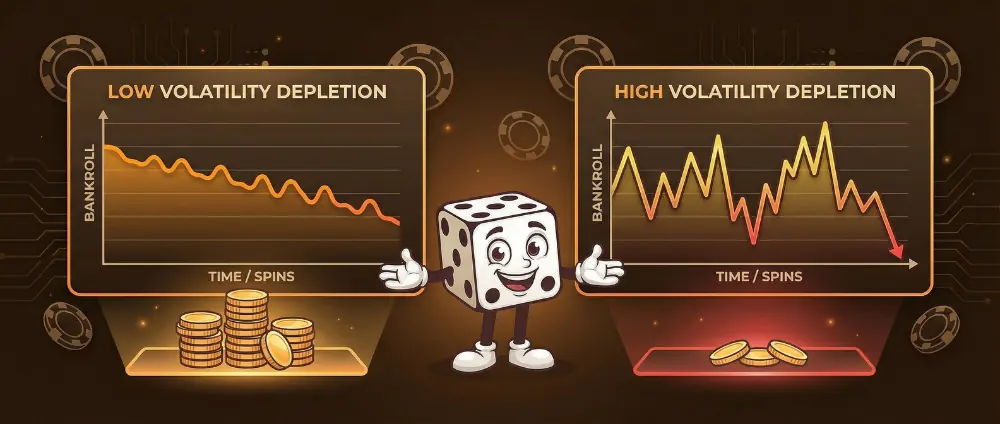
On low volatility slot, expect regular but small wins. Your balance does not change much. On a high volatility one big wins are possible but pretty rare. Your money goes down quick when nothing hits. In the middle is what they name medium volatility.
Based on slot machine research, designers sometimes use pretty complicated math to make many volatility types, while keeping RTP flat. Volatility is created by game providers purposely, which makes different types of slot sessions.
Slot Volatility vs RTP: Understanding The Difference
RTP (which stands for Return to Player) is just a percentage, and they figure this from millions of spins. 96% RTP means for every $100 you bet, the machine should return $96 during its whole existence. However, this number means not much in a 200-spin slot session.
Slot volatility, on the other hand, is about win risks and what patterns appear. It changes your short term results more than the theoretical RTP. Check out our Slot RTP Database and you shall notice that in short spinning, RTP bounces far from the number written in the rules, and slot volatility for beginners is the major reason why.
Here is a real situation:
- If you have low volatility plus 94% RTP, you can expect slow losses and normal little wins.
- With a high volatility plus 96% RTP, money drops suddenly, sometimes you get lucky on a big prize.
- Actually, you lose quicker playing on 96% RTP high volatility games.
RTP studies show variance impact on bankroll matters much more than RTP differences, especially if your budget is not very big. Two percent RTP up or down really does not change things in 500 spins, but volatility always decides if you can keep going that long.
High vs Low Volatility Slots: Key Differences
Traits of low volatility slots might look like:
- Getting wins every few times (hit rate is roughly 25-35%)
- Wins are often tiny (between about half and 5 times your bet)
- During losses, balance goes down only slowly
- Your money does not multiply fast
- Suited for those doing bonus wagering
In a different way, high volatility slots work a lot different:
- There is sometimes a long waiting time in between wins (hit rate around 10-20%)
- Prizes might be very large (could be from 50 to 1000 times your wager, even more)
- If no win, money falls fast
- Sometimes your bet can multiply but usually bankroll disappears
- Not so great if you try to meet the bonus conditions
Medium volatility slots try to achieve a balance. These are usually the ones you see most in casinos since both thrill-seekers and more relaxed gamblers will like them.
How Slot Volatility Affects Your Bankroll
Slot volatility changes how fast your balance drops. This is one of the most important things to know for bankroll management volatility, but is usually missed by most gamblers.
Suppose you play with $100 and every spin is $1:
Variance Impact on Bankroll
- If you pick low volatility, it is possible to play 300 to 500 spins before you lose your $100 deposit. Frequent small wins keep balance stable.
- With medium volatility game, your session can be finished in 150 to even 300 tries depending on win timing.
- But on high volatility, your balance might drop to $20-30 within just 50-100 spins unless a big win hits. Without that big win, you're out fast.
All three slots keep RTP the same. But with difference in volatility, experience changes completely. High volatility slots need a lot more cash to maybe win big by lasting longer. If you use $100 on slot with high volatility, you basically risk it hoping to get the only big win before your wallet is empty.
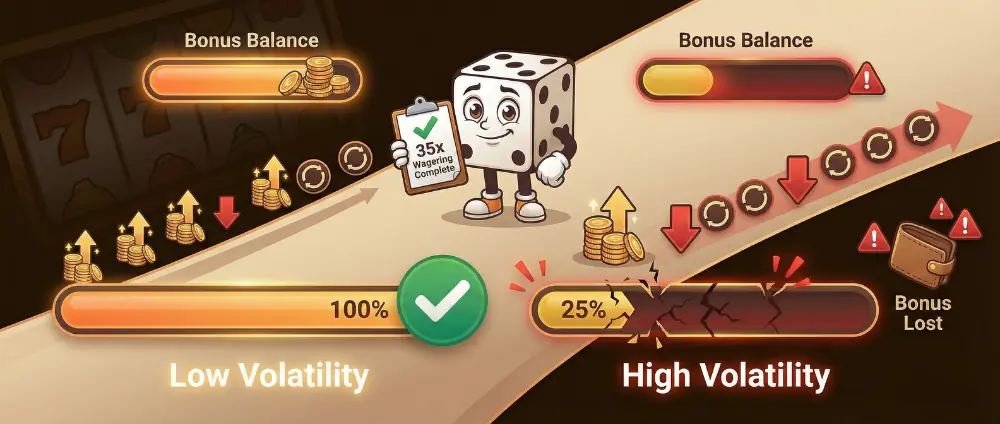
It helps to explain why most casino bonuses are lost quickly. Players go for high volatility slots, dreaming about massive reward, but sadly see their bonus balance fall to zero nearly before even 1/5 of wager goal. Here, short term variance slots do the damage before RTP is even useful.
Slot Volatility Explained Through Real Casino Testing
Our PlayAmo Casino review testing revealed the way volatility decides your outcome. The bet size is same, RTP is not different, yet outcomes feel totally different by volatility in a game.
Here is the comparison:
Low volatility slot (Book of Tribes) - out of 500 spins, balance ranged simply between around $25 and $45 most times
High volatility slot (Elvis Frog in Vegas) - after 350 spins, balance jumped between $15 and $65, eventually landing at $8
Even with RTP about the same, difference in volatility created a full new story for both sessions.
The low volatility game provided steady journey. Wins were not big but they came often and drop in cash was not abrupt. The higher volatility slot brought much more randomness - there were long, losing turns then suddenly a major prize then losses again. Money staked stayed the same, RTP average was same but the risk and excitement levels were opposite.
For more samples, see our RTP database details. Slots such as Gates of Hades with high volatility create real RTP numbers ranging anywhere between 34 and 94 in sessions between 200 and 500 spins. With low volatility, numbers stay much tighter closer to what the rules say.
Slot Volatility and Welcome Bonus Wagering
When it comes to slot volatility explained for bonuses, high volatility slots are really not good for bonus wagering. From my many tests on this, there is always the same thing showing up: high volatility gets rid of the bonuses quickly.
Here are some reasons slot volatility hurts the bonuses:
- Bonus amount you get stays same (you do not add new money in the middle of wagering)
- High volatility most often means you go through over 50 losing spins first before maybe getting a large win.
- Your available balance will hit zero most times before hitting the big win.
- Even a 96% RTP does not matter when you run out after getting just 15 percent through wagering.
If you look at the bonus variance article, there are examples showing how people had the same bonus rules and same bet amount but because of high vs low volatility slots got really different results. One person finished wagering, but the other person lost all of it after meeting 25 percent of wagering. The difference came from volatility and not RTP versus volatility.
The right way for bonus play is to pick low or medium volatility slots. You never get a huge hit but you have a better chance to complete the requirement for the wagering. If you finish a 35x wagering on a very low volatility slot, it is much better compared to busting at spin number 150 of a high volatility slot.
How to Check Slot Volatility Before Playing
Mostly casinos do not show volatility ratings, but there are some ways you can work it out:
- See paytable: When the top symbol pays 1000x bet or more, chances are it's a high volatility
- Look at features: Slots that got big bonus rounds are usually much higher in volatility
- Easy test bets: Spin with little bets for 50 spins - if balance does not move, this is lower volatility
- Read provider details: Some game makers give slot volatility for the beginners in game info
- Max win amount: Highest win past 5000x bet is high volatility, below 1000x is less volatile
Some makers put volatility ratings (words like low/medium/high or numbers 1-5) in the info section. Be sure to check when using bonus cash or your small bankroll.
For bonus play, better to avoid certain things: Try to skip slots with free spins paying 100x plus multipliers, progressive jackpots and those with megaways (over 100000 ways). These show variance impact on bankroll is high.
If playing for fun using your own cash, the slot volatility choice depends what you enjoy. If wanting maximum play hours, go with low volatility, but if you hope for large payouts then high volatility brings higher risks. Just know how volatility affects the RTP and how it decides your experience with the high volatility slot strategy and short term variance slots.
Related Pages:
Slot RTP Database - Real Testing Data
How RTP Affects Welcome Bonuses
Why Bonuses Die Early
Casino Rakeback Explained
Responsible Gambling Resources