What RTP Actually Means
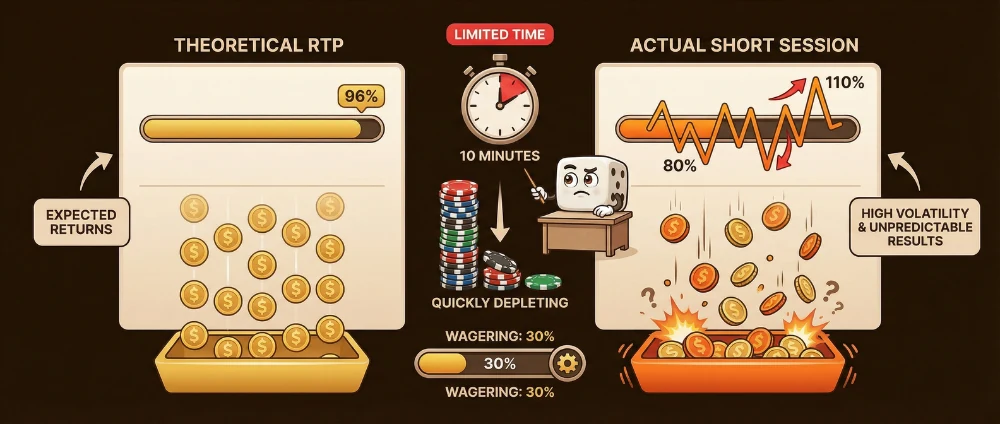
RTP, or Return to Player, is a popular casino indicator showing the expected percentage of all wagered money that a game should return to players over a huge number of bets. This concept is commonly misinterpreted, as a 96% RTP does not mean a player gets 96% of their wagers back in one play session. Rather than that, this percentage claims that across hundreds of spins, the game should pay back 96 units for every 100 units.
It is very important to understand the difference between theoretical RTP and what you see while gambling. Any game's Return to Player rate is measured based on thousands of spins, usually conducted by a special algorithm, to determine the potential returns. Real gameplay can, however, cause you to experience either large wins or longer losing streaks.
When trying to meet welcome bonus wagering requirements, bonus play RTP reality can be affected by session length, betting limits, and time constraints. While in theory the indicator stays the same, it can remain unseen in shorter gambling periods.
Remember that:
- Casino bonus terms can change anytime.
- We use real-life tests, but results may vary by player.
- Results depend on gameplay, timing, and individual approach.
How RTP Affects Welcome Bonuses
To understand the bonus wagering RTP impact, we need to draw a line between the game's Return to Player and the welcome bonus structure. While the basic RTP of a game is not changed when using a bonus, players must look out for other aspects, such as:
- The total amount that must be wagered (e.g., x30 or x40).
- The period in which wagering requirements must be met (e.g., 24 hours, 5 days).
- The results of short-term game variance (e.g., low, medium, high).
Tracking RTP is not the best way to judge results, especially when wagering requirements push players into placing many bets fast. Welcome bonuses have the tendency to make the variance risk higher while cutting down opportunities to make up losses.
While testing casino welcome bonuses, we found out that even slot machines offering theoretical RTP over the industry standard of 96% made big swings in results while bonuses were in use. This happened mostly because of the high number of bets placed during shorter sessions.
Expected vs. Observed RTP Bonus Outcomes
Looking at welcome bonuses, one must understand the gap between expected vs. observed RTP bonus results. The difference is a common cause of frustration among players who are not able to fully meet all wagering requirements in a given period.
Expected RTP is based on large sample sizes, has no time pressure, and has no money-related limits. On the other hand, observed RTP bonus outcomes reflect narrow balances, obligatory wager, and time constraints.
Basically, Return to Player is often seen from an imperfect and skewed viewpoint. When we were testing welcome bonuses, we experienced cases where bonus money ran out much faster than predicted by RTP. Short-term variance had the biggest impact in such cases.
Overall, the bonus terms RTP impact is what makes the final wagering results different from the ones expected on paper.
RTP Variance in Short Sessions
RTP variance in short sessions is one of the main factors determining the quality of your wagering attempts. This variance describes the extent to which actual results might differ from your expectations. And it matters even more during quick gambling sessions.
In most of the casinos we tested, welcome bonuses came with strict time limits. What these constraints meant for gambling is that everything had to happen really fast. Bonus funds could be available only for a few hours, and some wagering requirements had to be met within just a couple of days.
While testing welcome bonuses, RTP and variance, we monitored wagering sessions of comparable length and bet sizes on the same game. Our results showed significant variation, despite having equal rules and RTP. This fact cannot be avoided and gets amplified due to strict bonus terms and conditions.
Bonus Variance vs. RTP
Players often tend to misinterpret the relationship between bonus variance vs. RTP. Even if RTP levels are high, they do not decrease variation; rather, they merely improve the expected theoretical return over time. Many slot machines with RTP over 96% still exhibit high volatility, meaning payouts are rare but also substantial.
Comparing these characteristics becomes more problematic when bonus wagering is required by the casino. Going on a longer losing streak can quickly drain your funds, as big wins are often restricted, contained, or integrated into longer betting sessions.
We compared games with low, medium, and high volatility when trying to meet welcome bonus wagering requirements at various casinos. The outcome was that lower variance games paid out more often, even if the winnings were considerably smaller. Frequent wins make them a better choice in wagering, as high volatility slot machines can quickly drain your bankroll before completing all bonus conditions.
Does a Casino Bonus Change RTP?
Short answer is: no.
From a mechanical point of view, a casino game's RTP is set by its developer, and therefore cannot be altered by the gambling platform. However, we have seen different casinos offer different RTPs on the same game, as some providers allow operators to choose from multiple RTP configurations. Bonuses themselves do not have any impact on the game mechanics.
However, what changes when using a casino bonus is the list of games available for wagering. Many iGaming platforms we had tested proved to limit wagering to specific titles, excluding the ones with the highest RTP ranges. This way, casinos want to partially secure their advantage over players, leading them to adjust their betting patterns.
As a result, there is a common belief that bonuses decrease the actual Return to Player rates. The underlying mathematics stay constant, though.
Actual RTP Bonus Play Observations
While checking different promo offers and their details, we have managed to observe RTP ranges instead of fixed-point statistics. Our actual RTP bonus play observations include:
- The observed RTP in short wagering sessions differed from the mathematical predictions by approx. 15-25% across several thousand spins. Individual session swings can be far more extreme during the first few hundred spins.
- A few sessions exceeded the theoretical RTP but were held back by ongoing wagering or withdrawal limits.
For example, we were wagering a welcome bonus at an online casino, using a slot machine with a theoretical RTP over 96%. During our gaming sessions, the actual Return to Player shifted from the low 80s to more than 110%. This observed percentage was only determined by variance timing. For more real-world RTP data, see our Slot RTP Database.
Bonus Play RTP Reality
Bonus play RTP reality is determined by two factors:
- Mathematical principles: More bets bring results closer to theoretical RTP over time, but short sessions can still swing widely.
- Psychological view: Players view results related to their anticipations rather than actual chances.
Seeing RTP as a guarantee for a gaming session can lead to an incorrect perception of typical variation as unjust or manipulated. However, online casinos do not possess the tools to interfere with game mechanics, meaning the mathematical side of things remains unchanged. Bonus psychology is what leads players to unjustified reasoning that the bonus is crooked.
Which Bonus Structures Amplify RTP Variance
On our mission to determine how RTP affects welcome bonuses, we discovered certain promo structures that increase variance:
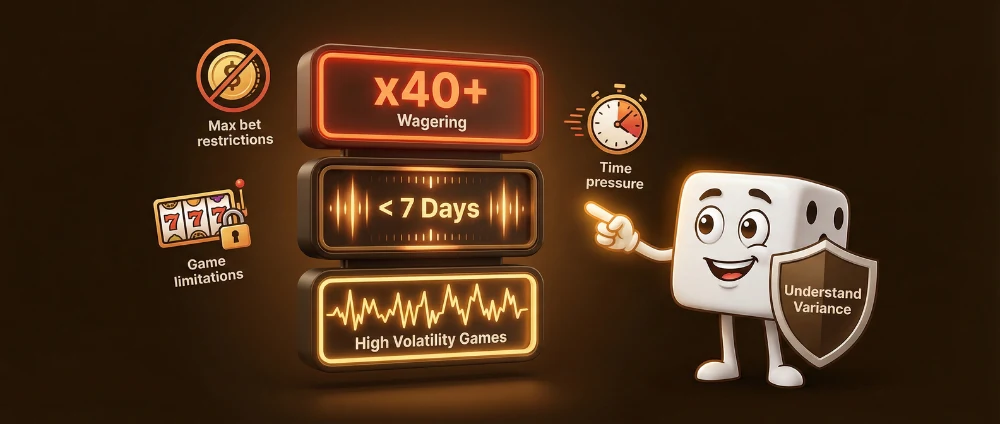
- Higher wagering requirements, i.e., x40 and more.
- Short fulfillment timeframes, i.e., less than 7 days.
- Strict maximum wager restrictions, i.e., less than 5 EUR (or equivalent).
- Required wagering on high volatility slot machines.
These bonus structures proved to play a vital role in expanding the gap between expected and actual RTP. Pressure put on players often leads to creating a bonus game reality that might seem unfair. While casino incentives are not automatically deceptive, they demand a thorough understanding of how variance works within given constraints.
Bonus Terms RTP Impact
Not every bonus we tested affected the observed outcomes of RTP in the same way. The most common bonus terms that impacted RTP were linked to:
- Reduced wagering requirements, i.e., below x40.
- Longer fulfillment timeframes, i.e., over 7 days.
- Broader game selection, i.e., more slot machines with higher RTP.
- Transparent wagering progress indicators, i.e., bets left to play out.
Even though the theoretical RTP cannot be improved by these impactful elements, they slow down variance, reducing sudden and random changes. The impact of bonus rules is therefore not direct but noteworthy.
How to Interpret RTP Claims Correctly
If you want to interpret claims related to expected vs. observed RTP bonus conditions, interpret this indicator as:
- Long-term potential return parameter.
- A tool to compare different casino games.
- Theoretical house edge.
On the other hand, we do not recommend viewing RTP as:
- Guaranteed return on investments.
- Bonus quality displays.
- Promises made for single sessions.
Remember that RTP is just one of the key factors when assessing welcome bonuses at online casinos. Wagering requirements, variance, time limits, and game selection also play an important role and matter a lot to actual promo outcomes.
Want to see how we test welcome bonuses? Learn our complete methodology and see real test results from actual casino bonuses in our welcome bonus testing guide.
FAQ
What Is RTP In Online Casinos?
RTP (Return to Player) is a percentage value that determines the predicted amount that you can recover from your investment in a casino game. This indicator is strictly theoretical, set by the game's developer, and cannot be interfered with by any gambling platform.
Does Higher RTP Mean a Safer Welcome Bonus?
Not quite. RTP rates do not reduce the short-term variance of any casino bonus. They are not an integral part of a bonus offer; rather, they describe the potential return that games pay out over a longer gaming period.
What Does 96% RTP Mean?
If a casino game offers 96% RTP, it means that 96 units from every 100 units invested in a game should theoretically return to the player. It does not, however, translate to certain winnings during any given session.